A place to pine and
suffer, Women Trafficking: The case of Albania.
‘Countries with more gender equality have better economic
growth. Companies with more women leaders perform better. Peace agreements that
include women are more durable. Parliaments with more women enact more
legislation on key social issues such as health, education, anti-discrimination
and child support. The evidence is clear: equality for women means progress for
all.’ – UN Secretary-General Ban Ki Moon
When I was asked to write a blog for the 16 Days of Activism my first thought was: this is a numbers
game. The 16 Days of Activism Against Gender Violence is an international
campaign originating from the first Women’s Global Leadership Institute in
1991.
For me, the symbolic link between violence against women
and human rights is nowhere more prevalent than in the global phenomenon of
human trafficking; although the
correlation doesn’t end there. I felt that writing a blog was a journey; that’s
how I viewed The 16 Days Campaign. It is a journey that’s built around a
network of significant places and the same can be said for victims of
trafficking.
When you run the
numbers, VAWG (Violence Against Women and Girls) and Human Trafficking really
add up.
Human Trafficking in Persons is ‘the recruitment,
transportation, transfer, harbouring or receipt of persons, by means of the
threat or use of force or other forms of coercion, of abduction, of fraud, of
deception, of the abuse of power or of a position of vulnerability; [a] person
having control over another person, for the purpose of exploitation. It
is a series of connected actions with the final purpose being a form of
exploitation (such as labour or sexual exploitation).
Human Trafficking is a serious crime and a
grave violation of human rights. For those who befall it, exploitation can last
anywhere from 16 days to 16 years and beyond.
Globally, trafficking
in human beings is a gendered phenomenon with women thought to be victims in
more than 80% of trafficking cases. Sexual exploitation is the most
prevalent form of trafficking with women constituting 85% of victims.
The Balkans, an oft over looked, oft
misunderstood region of the world is home to Albania, a country of 3.2 million
people. It remains one of the least known countries in Europe yet the number of
women seeking asylum and refuge in the EU is increasing year on year. In 2015,
Germany alone saw 54,762 applications for asylum (which rejected 99% of their
claims).
The Albanian constitution states: ‘All are equal before the
law.’ In spite of this, statistically it’s
women who are being trafficked from its borders. There are a number of social
and economic factors for this, but for numbers sake, I’ll focus on two.
According to the Home Office, in
Albania, some 53 percent of women will have experienced domestic violence
within the last 12 months.
Many of the women and
girls who are trafficked from Albania report fleeing forced marriages, and
domestic violence. Domestic violence
in Albania is a serious and widespread problem. According to the
Home Office, in Albania, some 53 percent of women will have experienced
domestic violence within the last 12 months. Violence against women is not only
perpetrated by current or former husbands/partners but also parents, brothers,
sisters, in-laws, and other relatives.
Albanian society is male dominated and in it women are taught to
obey their husbands and accept their submissive roles. Many are married for
dowries. Most women are expected to serve their families, bear children and
preserve Albanian cultural traditions all from the age of 14. In Albania the
age of consent is 14 years old for girls; however, if a girl has not
reached sexual maturation by age 14, sexual intercourse is still illegal. Age
then, is but a number.
In all societies,
cultural attitudes toward male honour serve to justify violence against women.
What’s more, you don’t need to be a mathematician to understand that such a
justification exacerbates its consequences. A culture that embraces male
masterdom over women encourages violence and it also encourages something else:
trafficking for the purposes of sexual exploitation.
This year, 22% of Hestia’s Human Trafficking Service referrals
have been Albanian women and children. According to Unicef, the duplicity of domestic violence and
human trafficking in Albanian women has meant that in some rural areas of the
country 90% of adolescent girls leave secondary school for fear of being
kidnapped. Additionally,
in their own guidance, a Home Office report found that in Albania close relationships
are often used to exploit and control others. There have been numerous
incidents where ‘boyfriends’ have groomed women into sexual exploitation.
Sadly, that’s exactly
what happened to Hannah:
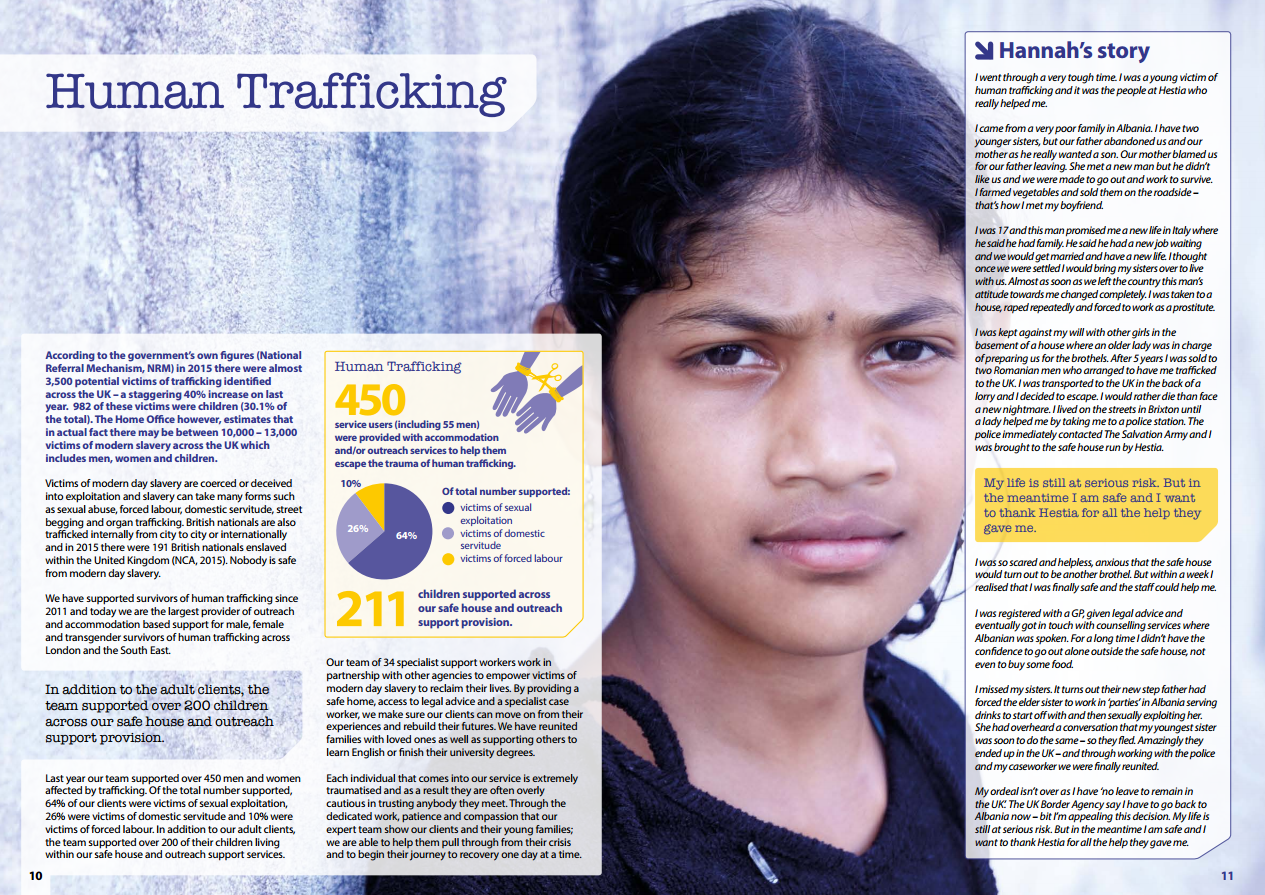
I went through a very tough time. I was a young victim of human
trafficking. I came from a very poor family in Albania. I have two younger
sisters, but our father abandoned us and our mother as he really wanted a son.
Our mother blamed us for our father leaving. She met a new man but he didn’t
like us and we were made to go out and work to survive. I farmed vegetables and
sold them on the roadside – that’s how I met my boyfriend. I was 17 and this
man promised me a new life in Italy where he said he had family. He said he had
a new job waiting and we would get married and have a new life. I thought once
we were settled I would bring my sisters over to live with us. Almost as soon
as we left the country this man’s attitude towards me changed completely. I was
taken to a house, raped repeatedly and forced to work as a prostitute. I was
kept against my will with other girls in the basement of a house where an older
lady was in charge of preparing us for the brothels. After 5 years I was sold
to two Romanian men who arranged to have me trafficked to the UK. I was
transported to the UK in the back of a lorry and I decided to escape. I would
rather die than face a new nightmare. I lived on the streets in Brixton until a
lady helped me by taking me to a police station.

In patriarchal
countries like Albania all men have power. For women like Hannah patriarchy,
abuse and sexual exploitation are commonplace. She couldn’t turn and face up to
violence and exploitation in Albania but we can.
No comments:
Post a Comment