Saturday, 17 November 2018

women and advertisements


As it is shown in those pictures the women are exposing their bodies in order to promote the products that the customers would like to buy. Different companies are using the women's images in order to sell their products and having benefits from them. So different companies have decided to make advertisements more attractive or to sound much more interesting to the customers by using women’s bodies, without showing interest in the way they represent women. They represent them as a sexual object only to attract people, especially men. There are lots of ways to promote a product. Why do we have to use women’s bodies in advertisements?


Mechanism of Gender Equality in Albania


- Commission for health, labour and social issues – is a commission within the Parliament of Albania handling,
mongst the others, also the issues of gender equality.
- Department of Social Inclusion Policies and Gender Equality (DSIPGE) – is a Department at the Ministry of
Social Welfare and Youth. This Ministry is the responsible government body for promotion of gender equality
in Albania. DSIPGE is a structural part of the Ministry, originally (in 2006) vested with the tasks of formulating
and development of policies for gender equality and reduction of domestic violence. Currently, DSIGE
mandate is to mainstream programs of social inclusions with gender equality.
- National Council of Gender Equality – is an advisory body for gender equality established by order of Prime
Minister 3/2009 pursuant to Law no 9970/2008. The Minister of Social Welfare and Youth leads the Council in
his quality as the chairman. This national advisory body is composed by 9 vice ministers’ dhe 3 represatives of
civil society. This council provides relevant opinions and recommendations on approval of legal and sublegal
acts on gender equality, various reports on monitoring gender equality application and gender based violence;
in addition, such structure gives recommendations to be taken into considerations by local and central
institutions during exercition of their tasks on promotion and protection of gender equality and fights against
domestic violence.
- Commissioner for the Protection against discrimination (CPD) - CPD was created in accordance with the Law
“On the protection from discrimination”, as an independent institution which ensures the effective protection
from discrimination and any other form of behavior that incites discrimination as provided by specific law. CPD
is responsible to examinate the complaints of subjects which claim to have been victims of discriminatory
behaviors, both from the public administration and from private subjects. In addition, the Commissioner
undertakes administrative investigations after receiving information for violation of the discrimination law, and
performs monitoring of law enforcement. CPD issues recommendations that should be executed by private
and public subjects, otherwise sanctions are applied as provided by law. Notwithstanding, the sanctions, CPD
may oblige the subjects to undertake actions for informing and raising the awareness of the community, public
administration bodies and private entities, to promote the principle of equality and non-discrimination.
- Referral mechanisms – are gender employees in local and central bodies established pursuant to law on
gender equality. Gender employees are civil servants educated with gender issues and principles, gender
budgeting, gender equality laws etc. They exercise their functions in any local and central unit of public
administration. Up to september 2013, only three ministries had appointed gender employees; all other
ministries have focal point on gender issues; only in 17 units of local authorities there are offices for gender
equality; in 46 other local units focal point on gender issues are established.
- Ombudsman – is an institution not listed as a mechanism for gender equality by the public administration
relevant reports. Notwithstanding the fact that gender equality legal framework does not provide specific tasks
for Ombudsman, taking into consideration that i) the tasks conferred by law to the Institution for the protection
and promotion of human rights, ii) gender equality is substantial part of human rights, it is in the very
substantial nature of the work of Ombudsman to play an imense role for achieving gender equality in the
country.
In light of the above, it results that in Albania there are some nechanisms for addressing gender inequalities, but
there is no dedicated authority for this purpose, such as a national authority for gender equality, as it is in Portugal33 or in
Croatia.
4. Conclusions
- Albania has an advanced legal framework on gender equality;
- Domestic laws imply international standards for protection of women rights;
- Albania has established mechanisms to address inequalities;
- Gender equality and women empowerment is still a challenge in Albania, especially with regard

Sexism Against Women on Internet Blogs and Forums

This links show us about sexism, based on real fact. Read. more down below.

The Happy Housewife

Artifacts showing women in the home environment can create the impression that cooking and cleaning should be a woman’s primary occupation.

Add caption
 

Women and advertisements

Here are presented two different concepts of "the perfect body". First picture presents the skinniest and thinnest models, who happen to be the most famous also. So, the impact that these women have in the ordinary girls life is huge. They are very popular and are followed by many girls in social media and everywhere, so they impact on their thoughts about their body image is big. The other picture is closer to reality. Not all girls in this world are thin and in great shape. In my opinion, there is no such thing as "the perfect body". The most important thing is to be healthy(and by this I mean not affected by any disease), and to feel comfortable with the body you have and not to be worried by other people's opinions. Because we do not live for the others but for ourselves.
This picture presents a half- naked woman who advertises a kind of drink. It is clear that she is "dressed" like this in order to attract people to buy that drink, especially men. Also the woman is in "perfect" body shape, as many males think a woman should be.

Friday, 16 November 2018

Women Trafficking. The case of Albania.


 A place to pine and suffer, Women Trafficking: The case of Albania.
‘Countries with more gender equality have better economic growth. Companies with more women leaders perform better. Peace agreements that include women are more durable. Parliaments with more women enact more legislation on key social issues such as health, education, anti-discrimination and child support. The evidence is clear: equality for women means progress for all.’ – UN Secretary-General Ban Ki Moon
When I was asked to write a blog for the 16 Days of Activism my first thought was: this is a numbers game. The 16 Days of Activism Against Gender Violence is an international campaign originating from the first Women’s Global Leadership Institute in 1991.
For me, the symbolic link between violence against women and human rights is nowhere more prevalent than in the global phenomenon of human trafficking; although the correlation doesn’t end there. I felt that writing a blog was a journey; that’s how I viewed The 16 Days Campaign. It is a journey that’s built around a network of significant places and the same can be said for victims of trafficking.
When you run the numbers, VAWG (Violence Against Women and Girls) and Human Trafficking really add up.
Human Trafficking in Persons is ‘the recruitment, transportation, transfer, harbouring or receipt of persons, by means of the threat or use of force or other forms of coercion, of abduction, of fraud, of deception, of the abuse of power or of a position of vulnerability; [a] person having control over another person, for the purpose of exploitation. It is a series of connected actions with the final purpose being a form of exploitation (such as labour or sexual exploitation).
Human Trafficking is a serious crime and a grave violation of human rights. For those who befall it, exploitation can last anywhere from 16 days to 16 years and beyond.
Globally, trafficking in human beings is a gendered phenomenon with women thought to be victims in more than 80% of trafficking cases. Sexual exploitation is the most prevalent form of trafficking with women constituting 85% of victims.
The Case of Albania
The Balkans, an oft over looked, oft misunderstood region of the world is home to Albania, a country of 3.2 million people. It remains one of the least known countries in Europe yet the number of women seeking asylum and refuge in the EU is increasing year on year. In 2015, Germany alone saw 54,762 applications for asylum (which rejected 99% of their claims).
The Albanian constitution states: ‘All are equal before the law.’ In spite of this, statistically it’s women who are being trafficked from its borders. There are a number of social and economic factors for this, but for numbers sake, I’ll focus on two.
According to the Home Office, in Albania, some 53 percent of women will have experienced domestic violence within the last 12 months.
Many of the women and girls who are trafficked from Albania report fleeing forced marriages, and domestic violence. Domestic violence in Albania is a serious and widespread problem. According to the Home Office, in Albania, some 53 percent of women will have experienced domestic violence within the last 12 months.  Violence against women is not only perpetrated by current or former husbands/partners but also parents, brothers, sisters, in-laws, and other relatives.
Albanian society is male dominated and in it women are taught to obey their husbands and accept their submissive roles. Many are married for dowries. Most women are expected to serve their families, bear children and preserve Albanian cultural traditions all from the age of 14. In Albania the age of consent is 14 years old for girls; however, if a girl has not reached sexual maturation by age 14, sexual intercourse is still illegal. Age then, is but a number.
In all societies, cultural attitudes toward male honour serve to justify violence against women. What’s more, you don’t need to be a mathematician to understand that such a justification exacerbates its consequences. A culture that embraces male masterdom over women encourages violence and it also encourages something else: trafficking for the purposes of sexual exploitation.
This year, 22% of Hestia’s Human Trafficking Service referrals have been Albanian women and children. According to Unicef, the duplicity of domestic violence and human trafficking in Albanian women has meant that in some rural areas of the country 90% of adolescent girls leave secondary school for fear of being kidnapped. Additionally, in their own guidance, a Home Office report found that in Albania close relationships are often used to exploit and control others. There have been numerous incidents where ‘boyfriends’ have groomed women into sexual exploitation.
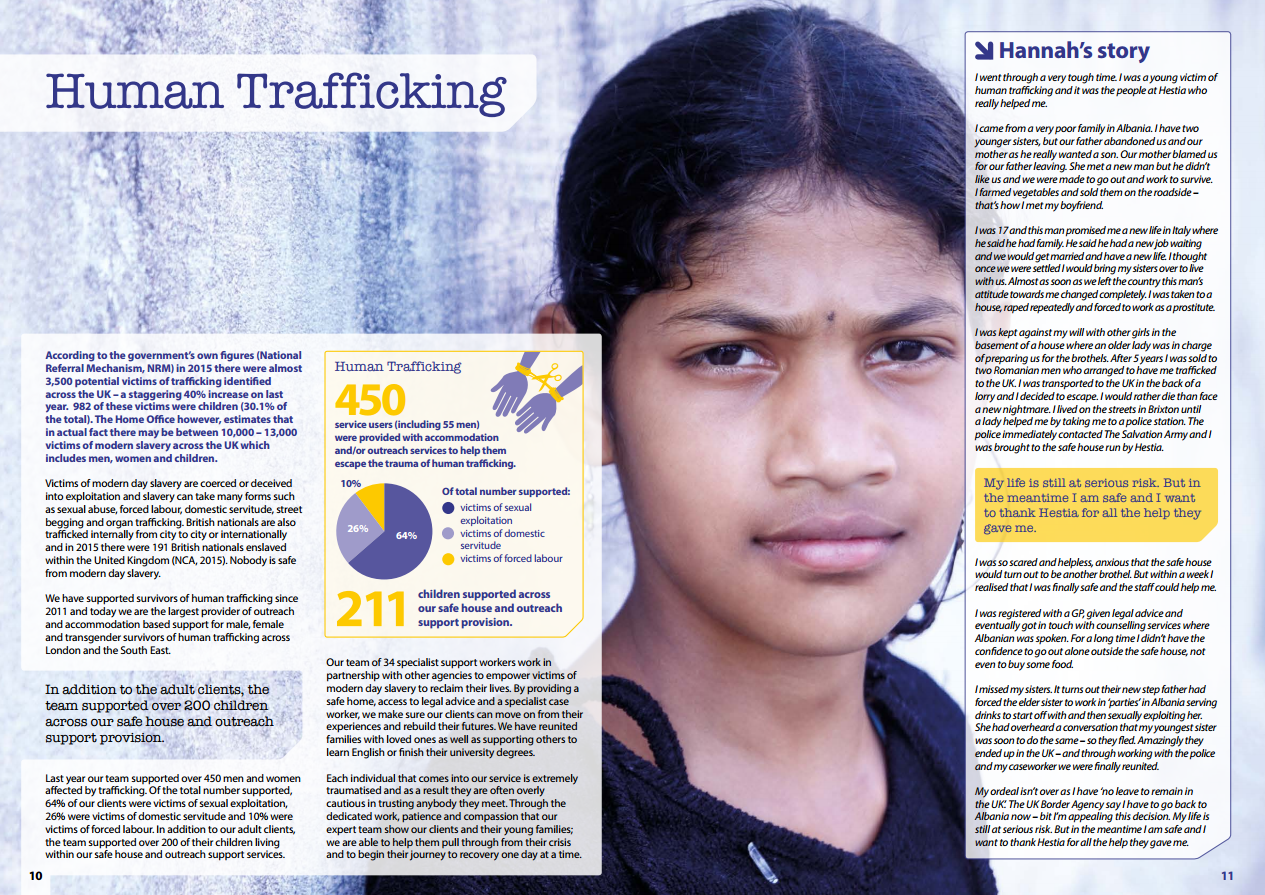
Sadly, that’s exactly what happened to Hannah:
I went through a very tough time. I was a young victim of human trafficking. I came from a very poor family in Albania. I have two younger sisters, but our father abandoned us and our mother as he really wanted a son. Our mother blamed us for our father leaving. She met a new man but he didn’t like us and we were made to go out and work to survive. I farmed vegetables and sold them on the roadside – that’s how I met my boyfriend. I was 17 and this man promised me a new life in Italy where he said he had family. He said he had a new job waiting and we would get married and have a new life. I thought once we were settled I would bring my sisters over to live with us. Almost as soon as we left the country this man’s attitude towards me changed completely. I was taken to a house, raped repeatedly and forced to work as a prostitute. I was kept against my will with other girls in the basement of a house where an older lady was in charge of preparing us for the brothels. After 5 years I was sold to two Romanian men who arranged to have me trafficked to the UK. I was transported to the UK in the back of a lorry and I decided to escape. I would rather die than face a new nightmare. I lived on the streets in Brixton until a lady helped me by taking me to a police station.


In patriarchal countries like Albania all men have power. For women like Hannah patriarchy, abuse and sexual exploitation are commonplace. She couldn’t turn and face up to violence and exploitation in Albania but we can.


Wednesday, 14 November 2018

Gender equality in Albania

http://www.al.undp.org/content/dam/albania/docs/STUDIMI_PERCEPTIMET_eng.pdfhttp://www.al.undp.org/content/dam/albania/docs/STUDIMI_PERCEPTIMET_eng.pdf

Assignment example

All students registered as authors can post pictures by clicking New Post on the top right corner of the blog. Then you can write a subject and a brief description or comment about the picture. Next,  you can upload the picture you have stored in your phone. I am using this picture as an illustration.


FINAL RESEARCH PAPER

the bluest eye cross cutting themes WOMEN AND FEMININITY theme The Bluest Eye  is mostly concerned with the experience of African-...